Where do I belong? Where are my roots? Is my heart divided, or has it just grown bigger?
Isabel Allende raises these questions in the preface to her novel A Long Petal of the Sea, and they are questions I have been asking myself, in one form or another, for most of my life.
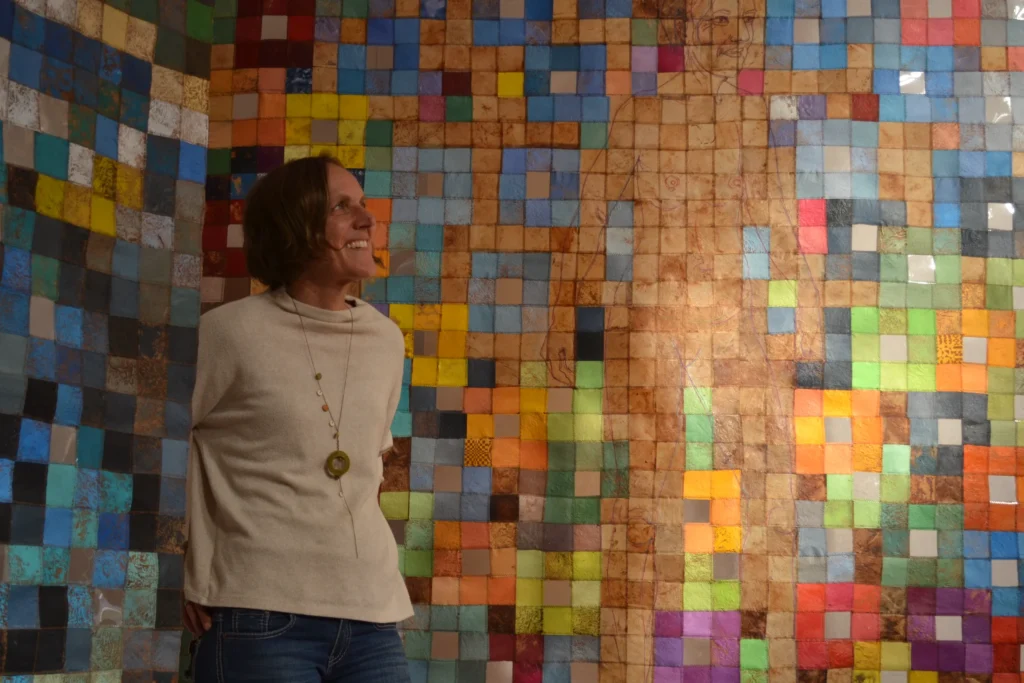
I was born in Johannesburg in 1972 to German immigrants who had become naturalised South Africans — giving up their German citizenship, but never losing their German roots. I attended the Deutsche Schule Johannesburg. I learned Afrikaans before I learned English, on our neighbour Kobus Kruger’s lap in a cul-de-sac in Northcliff. As a child I spoke three languages fluently.
At school I was not considered a real German — not like the children actually born in Germany. At university I was not a real South African — not like the English-speaking students who communicated with a lightness I had to work years to acquire.
I speak German. But am I German? I speak Afrikaans. But am I an Afrikaner? I speak English. What the heck does that make me?
Being of multiple nationalities, languages and identities can be both enriching and bewildering. For a long time it was more the latter than the former.
Marriage took me to Gobabis — a small Kalahari farming town in Namibia, predominantly Afrikaans and German-speaking, close-knit in the way that small towns are, with their unwritten codes of conduct that nobody hands you when you arrive. I was labelled an Engelsmens (Englishman) despite the fact that my mother tongue is German and I spoke fluent Afrikaans. I did not own a car, so I rode my bicycle everywhere — baby in a carrier, shopping slopped over the handlebars. I was the vet’s wife, and such behaviour was considered unbecoming.
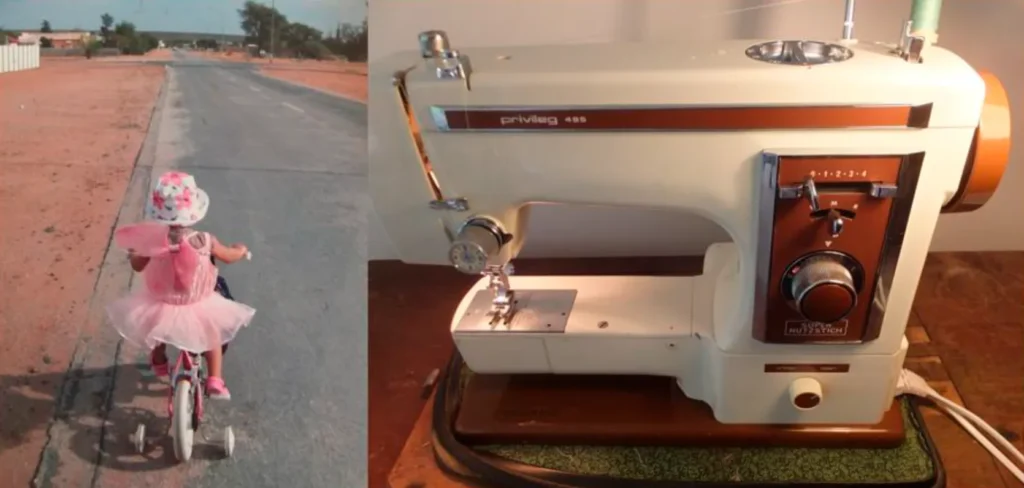
Right: Oma Lisa’s old sewing machine used to make my first colourwash quilts with the Magrietjies and still whizzing as it sews together teabags way more competently than any new-fangled sewing machine.
du gehörst: jy behoort: you belong
Frightened baby cries, shaken, near miss, bicycle almost topples as Shoprite bags on handlebars drag bike down towards dusty ground.
Red-faced wife jumps out of car.
“Hoe durf jy so rondry, as die dokter se vrou?”
Shamed disbelief.
But why is Afrikaans wife shouting, when she almost hit us with her car?
Angry car races down hot, bothered road.
Why didn’t you say something, anything? Why?
Tears and dust mingled mess wiped from eyes, frightened baby’s and her own.
You don’t belong! You should be ashamed! Behave!
Domestic workers, gardeners and volunteers peddle these dusty streets.
Not you.
How dare you, doctor’s wife?
“Could you pick me up on your way to quilting? My sewing machine won’t fit on my bike,” bike girl asks, voice too high, trying so hard.
So hard.
Dentist’s wife’s silence echoes in a make-up-strained smile.
Trying so hard.
So hard.
Bike girl presses Oma’s sewing machine to her heart.
She walks into the Magrietjie quilter’s midst.
Trying so hard.
So hard.
Silence echoes in make-up-strained smiles.
Oma, ich vermisse dich so sehr, bike girl sighs.
Two colourwash quilts hang side by side.
One neat and tidy, skoongemaak, like well-swept sand in their yards.
One wild and crazy, all awash with colour, rhythm… singing.
“Dis so lelik!” Afrikaans wives wince.
It’s so beautiful, bike girl’s heart sings.
She’s fallen in love with that loose and lovely thing.
Sewing machine stitched fragments, memory and moment, side-by-side.
Ach Oma, ich vermisse dich so sehr.
Tears dissolve make-up strained smile
“Ek het jou nooit verstaan nie.
Maar laslap, na pragtige laslap, is jy in my hart gelas.
Ons gaan jou baie, baie mis”
Farmer’s wife stands trembling, sharing her shaking heart and love.
But quilt after quilt, you were stitched into my heart.
We will miss you very, very much.”
She speaks for all.
Heels that would turn away in disdain, stand trembling, tender.
Healing.
Farewell, bike girl, wild colourwash-maker.
We understand, accept.
“Jy behoort”.
You belong.
Years of sewing, quilt by quilt, knit hearts and lives together.
I will miss you, wives, mothers, quilters…women.
Ich werde euch vermissen,
Magrietjies.
Leaving so hard. So hard.
She presses Oma’s sewing machine to her heart
And walks away.
Quilting is traditionally a communal activity, forging deep relationships. Namibian women in farming communities come together regularly, leaving their isolated farms up to 250km from town once a month to ‘kuier’, making quilts, drinking tea, and sharing news from the farm. In a central farming town such as Gobabis, women go shopping to stock up on essentials, attend church, or participate in activities like quilting groups. The Magrietjies is not just a place to share creative ideas and make beautiful things; it is also a place to share stories about the farm, the children, the heart…and ‘koek en tee’. The rituals of gatherings and communal activities are different and very specific to cultural communities. In the Afrikaans culture, there will always be an elaborate spread of both savoury and sweet treats for ‘koek en tee’, with a sprinkling of biltong, just for good measure, whereas I encountered a ritualised ‘Kaffee und Kuchen’ tradition amongst the Namibian German community. Magrietjies is a predominantly Afrikaans group with their specific set of traditions and values. Care and generosity are infused in everything these industrious women make. Hands move, sewing machines sing, whilst ladies chatter.
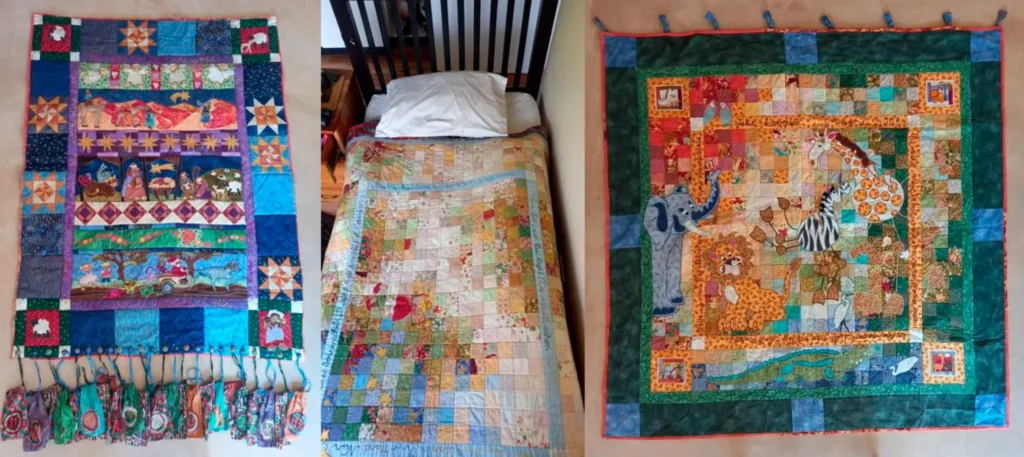
The proverbial rite of passage had been making one quilt after another. I had shown consistent commitment to the group. I had shown that I could make something ordered and meticulous. It felt good to belong. I learnt so much from these women, whose organisational skills and ordered existence allow them to manage their farming lives in environments that are sometimes hundreds of kilometres away from the nearest town. I learnt about the importance of these get-togethers, which form deep bonds of friendship and understanding. I was privileged to be ‘invited in.’
I appreciated being included in the quilting group, but the experience raised questions about who belongs and who does not. Initially, my behaviour, appearance, and language seemed to be an insurmountable barrier. Listening to stories about farms, children and lives lived in a challenging arid environment made me appreciate the effort, care and organisational skills it takes to coordinate life in the Kalahari. Even though I was initially precluded from belonging, I was privileged to be white. I suspect that my whiteness afforded me the luxury of asking to join, getting a lift with my sewing machine and participating in the quilting group without the fear of an outright rejection. I met Herero and Damara women who owned seamstress shops on Gobabis’s busy main road. Could they have joined? Perhaps they would never have asked, or they did not know about the Magrietjies who gathered in the ‘kerksaal’. The seamstresses along the Gobabis main road were engaged in the economic enterprise of making colourful, traditional clothes. Gobabis’s women shared an affinity for working with material, making patchwork items and other beautiful things, yet, across racial lines, I seldom saw women connect.
The cultural and racial make-up I encountered in the Big Bend, a farming area of Eswatini’s lowveld where I later lived, was far more varied. Mauritian, Zimbabwean, Zambian, South African and Mozambican families worked and lived in the ‘Ubombo Sugar Village’ as expats. The overall makeup of Big Bend was predominantly Swati, but events and activities held in the community mirrored the cultural diversity of the town. Compared to South Africa and Namibia, it was easier to become part of this varied farming group. Having been mostly self-governing, Eswatini has not suffered from colonial and apartheid oppression as much as its neighbouring countries have. Michael Stern, the founder of Waterford Kamhlaba, was therefore able to start a non-racial school in Eswatini. For the past nine years of my working career, WK has been the most culturally diverse place that I have been privileged to be a part of.
Integrating into a community is not easy. Years of moving have taught me valuable skills of finding connections in new places, although I always felt vulnerable in the process. Being white in Southern Africa means that, along with the privilege accorded, I carry with me the baggage of a colonial and apartheid past.
In The Light We Carry, Michelle Obama speaks about a state of being ‘comfortably afraid,’ an ability to coexist with jeopardy. Not being afraid of uncertainty allows for an internal dialogue, questioning myself within the context of culture, coexisting within various environments and allowing the places I have lived to shape my enquiry around belonging. Being uncomfortably comfortable in a liminal space of uncertainty has sometimes felt easier to exist in than a place of certainty. I am white. I am South African. I am German. But I am also a woman, mother, friend, neighbour, teacher, and artist. Throughout 360[5] Aspects of [Be]longing, I consider [be]longing (being, longing, and belonging) through the lens of time and memory, at a time when my children are flying the nest, and I look back with nostalgia, and look forward with curiosity, whilst trying to embrace my present reality.
Belonging, I have learned, is not a destination. It is a practice. You do it teabag by teabag, colour by colour, stitch by stitch. You do it imperfectly and with fraying edges and in the full knowledge that what you make is fragile and will not last forever.
And then you hold it up to the light, and it glows.