
November 2025. Johannesburg, South Africa.
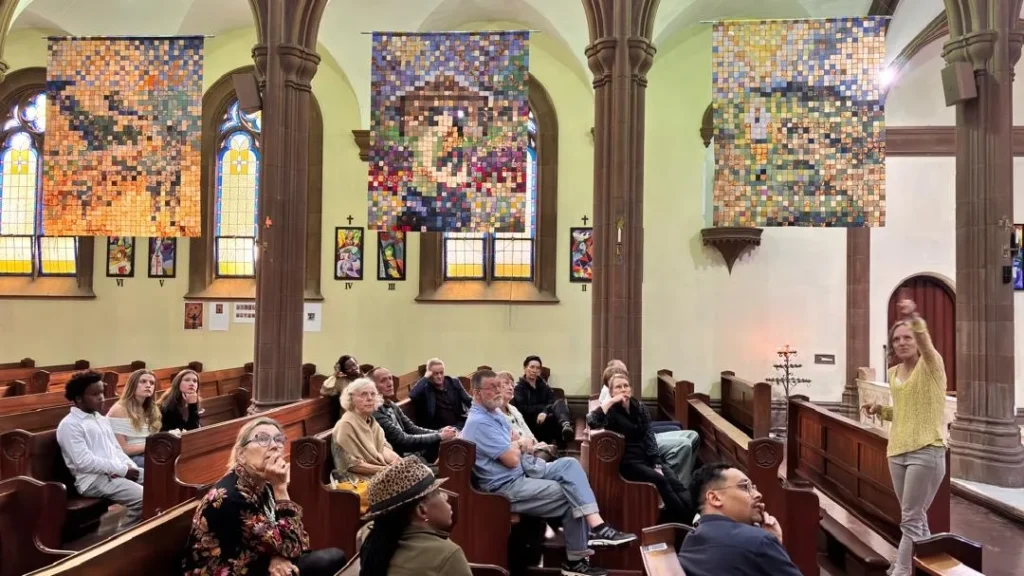
Holy Trinity Catholic Church sits quietly at the edge of one of the city’s loudest neighbourhoods — a sanctuary tucked between the University of the Witwatersrand and the noise and energy of inner-city Joburg, its arches and cool marble interior holding a particular stillness that the street outside does not. I had walked past it many times. I had never imagined my work inside it.
When I first stepped through the doors, I knew I wanted my quilts to be a part of the serenity of the space.
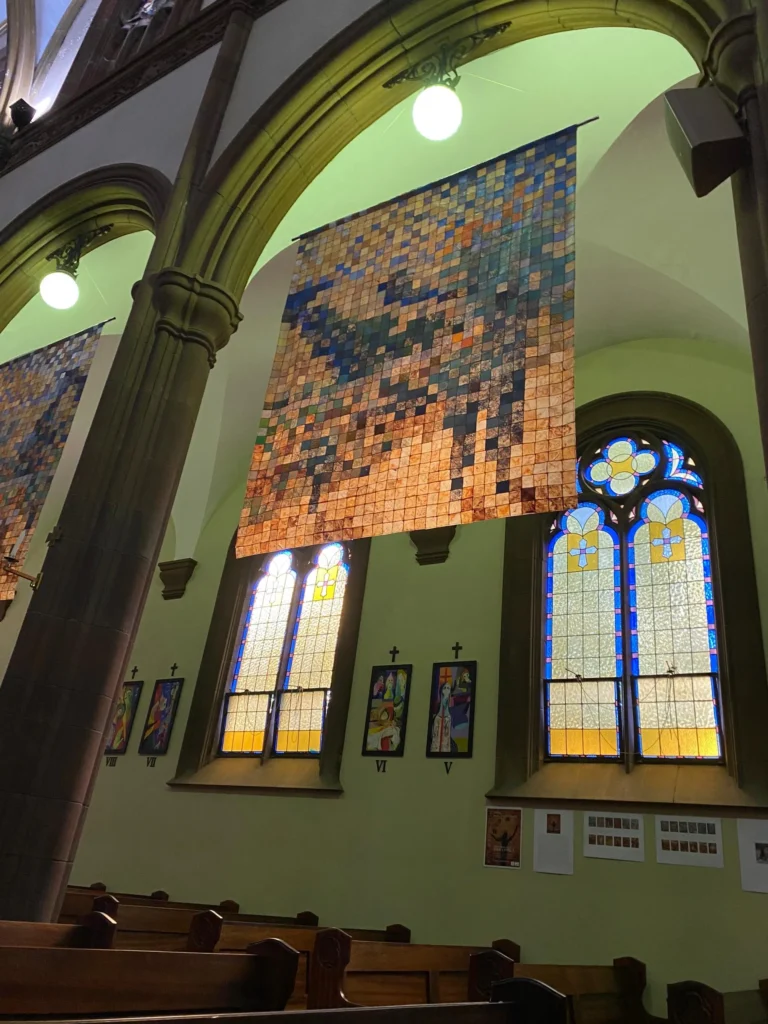
When the artworks finally hung in the arches of Holy Trinity Catholic Church, I was exhausted and relieved. The process of installing the exhibition had been nerve-wracking, and I would have never managed, had it not been for my son Jake and Bob Forrester.
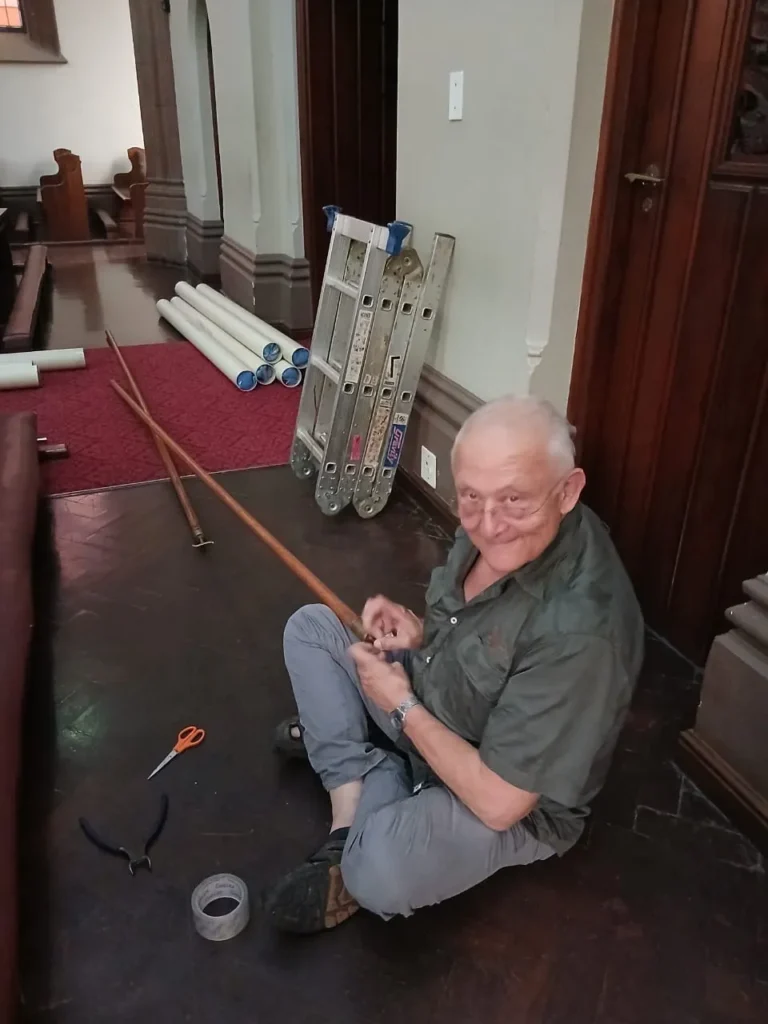
The exhibition was held at the end of November, end-of-year crunch time with report writing, tying up loose ends and winding down a hectic year at work. A week before leaving Eswatini and driving to Johannesburg, I phoned Bob, who had previously taken pictures of my art quilts, asking him to assist me. The three of us were a formidable team. None of the delicate lights in the arches broke, no one fell off a ladder and all the art quilts remained more or less intact. When it was done, I took a deep breath and looked around; I was overwhelmed by a sense of wonder. The art quilts looked like they belonged in the space. Even though I had not made the art quilts for the arches, they fitted perfectly.
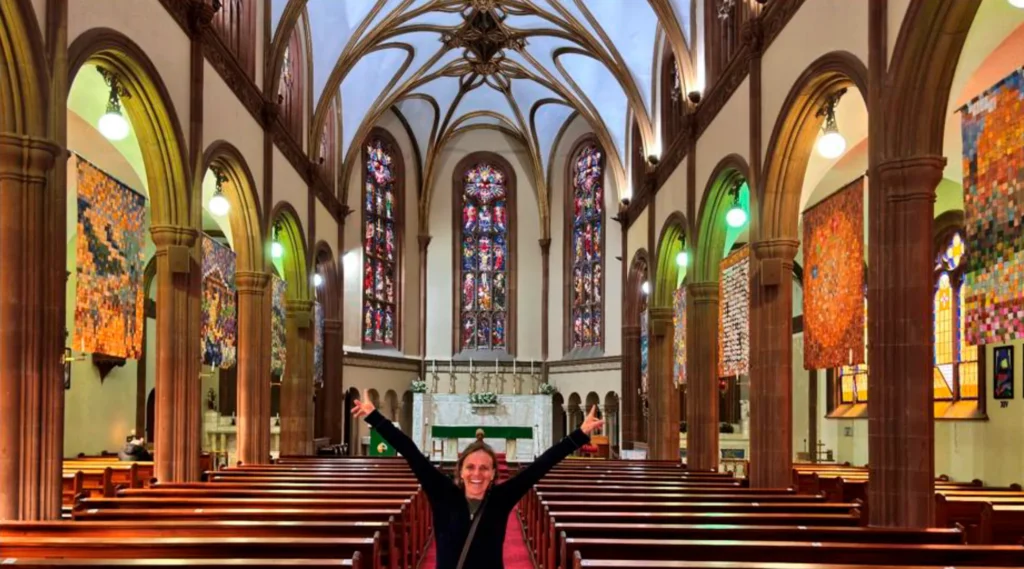
After two days of installing the exhibition, I experienced a subtle shift. When I initially carried the work into the sacred space, I felt awkward and nervous, finding the quiet Catholic church a foreign and intimidating environment. As we started hanging the exhibition, measuring and cutting fishing line, precariously standing on ladders and gently hooking the fishing line over the wrought iron spirals, I slowly started feeling a sense of ease and belonging.
The last art quilts to be hung were those at either side of the altar. When I stepped back down into the sacred space, I recognising how significant it was that November: Lweti: When it Rains, and December: Ingongoni: Stilbaai hung on either side of the altar.
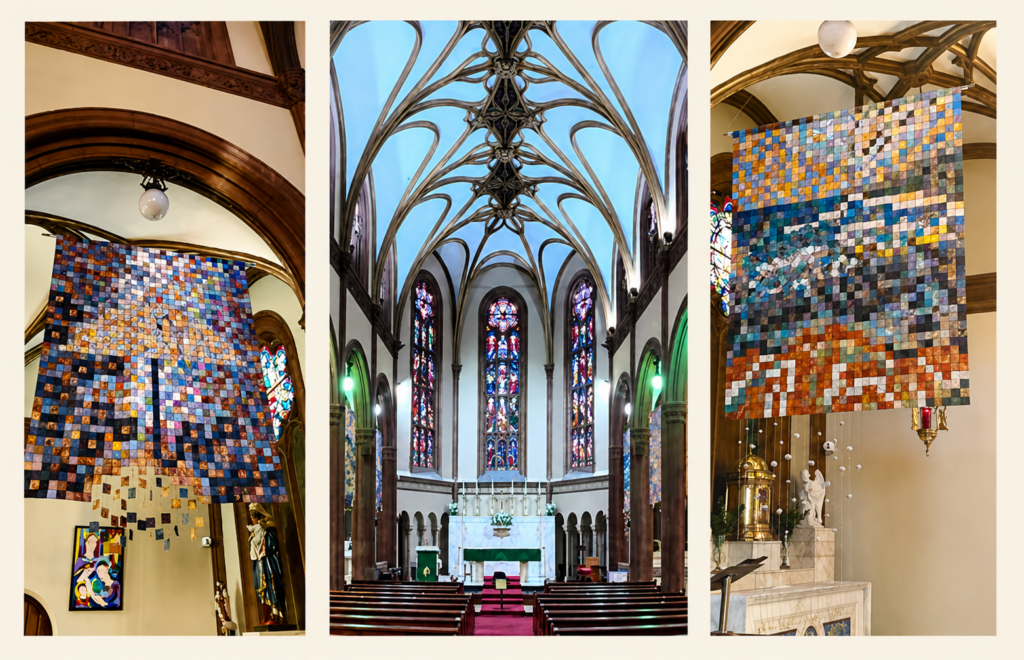
As I stood barefoot on the cool marble balustrade, I had a sense of peace, an inner quiet and equanimity; the sense of ‘take your shoes off, you are standing on holy ground’ (although, admittedly, I had worked barefoot throughout the two days).
The exhibition was a sucess, but not easy. I was uncomfortably comfortable in the space. But that is what the concept of finding [be]longing is all about.
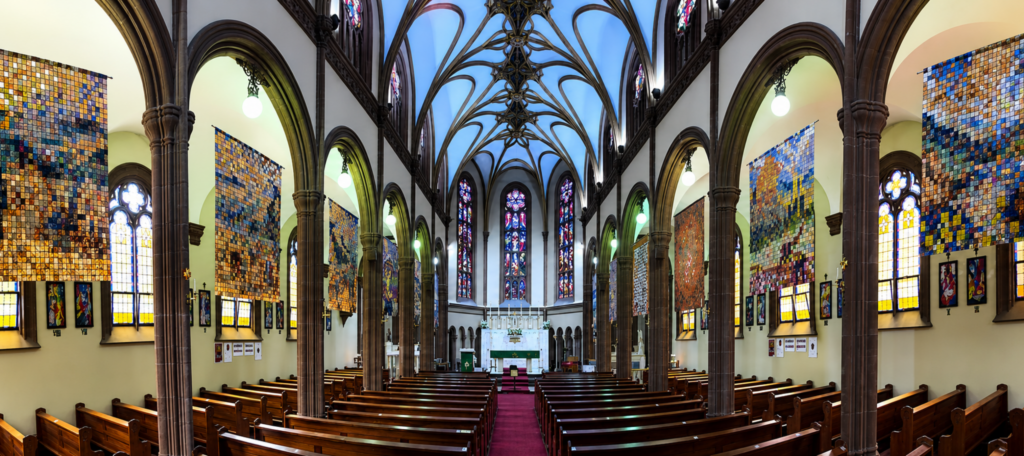
It is not a neutral space, considering the Catholic church’s history, a dominant, powerful, political past. Hanging the work at Holy Trinity Church was being welcomed into the space as a guest. Looking at the art quilts themselves, quietly suspended in the arches, I had a sense that they too had taken their place as guests, in a celebratory manner.
Although I had had a strong inkling that the art quilts would fit into this church, it was only when they were finally installed that the beauty and balance between the space and the work became visible. The stained-glass windows and the art quilts are similar: they infuse the space with warm colour and dappled light. There is a symbiotic relationship that develops between the two, with neither dominating the other.
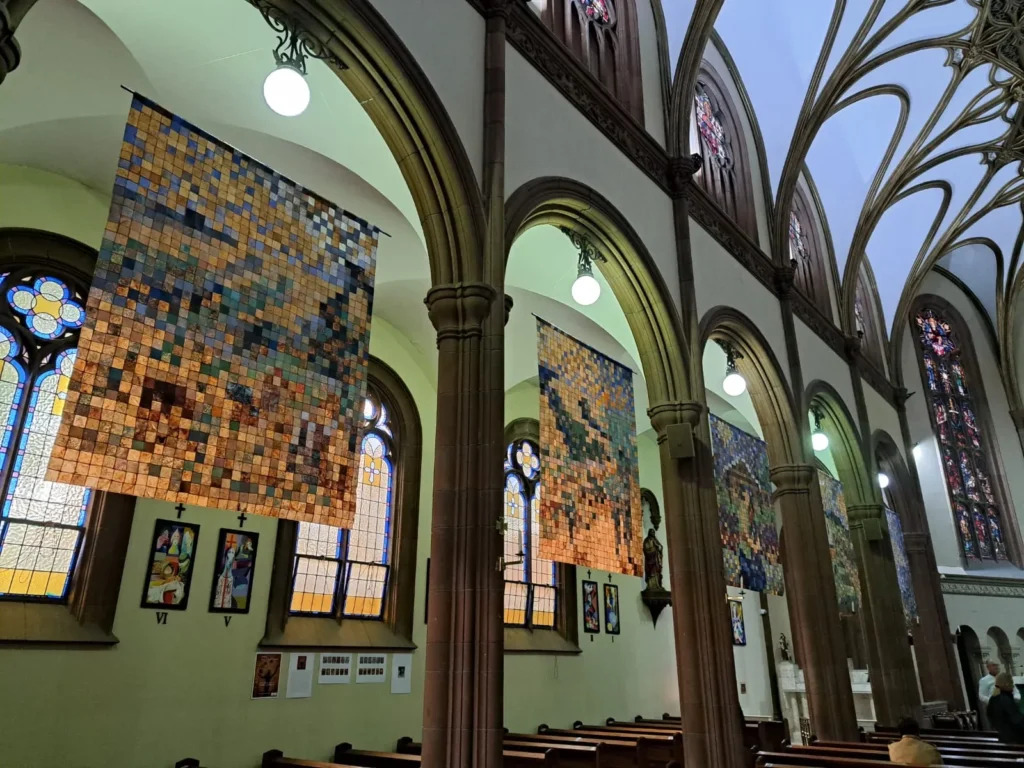
I did not envisage the art quilts as site-specific artworks for Holy Trinity, and yet, they somehow seem designed with that space in mind. The size is just right, with the quilts fitting comfortably into the arches, almost like ancient banners, swaying in the breeze, not too large nor too small. The number of works was perfect: there was one art quilt for each of the twelve arches. Arranging them in the sequence of the twelve months, with November and December finding their unique position in the sacred space beside the altar, adds depth to the relationship between the space and the work. The changing light, illuminating the art quilts differently depending on the time of day, adds nuance, kinesthetic movement and ‘lightness’ to the artworks.
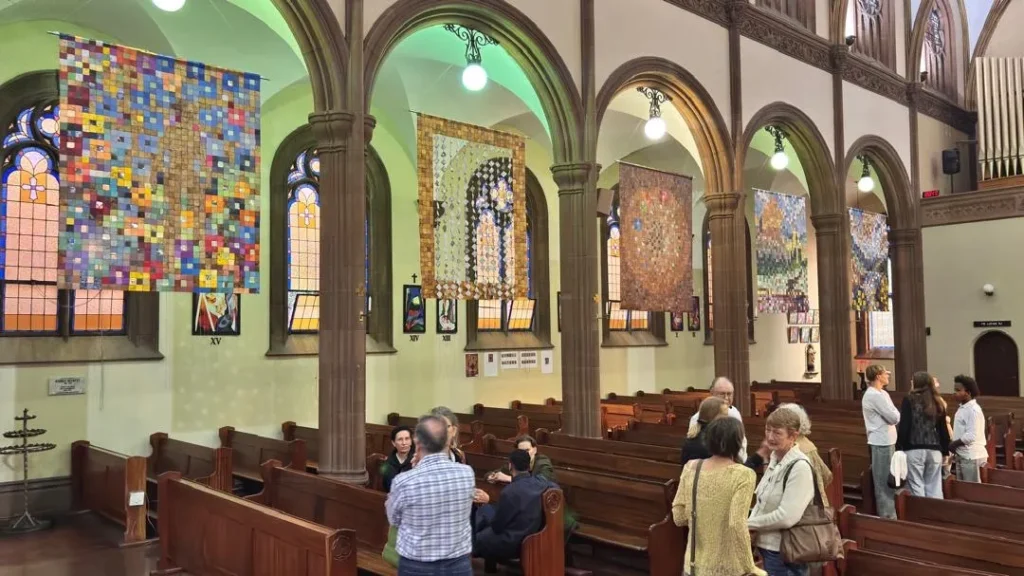
The church, positioned in the hustle and bustle of Johannesburg’s CBD, surrounded by WITS, is a quiet, contemplative sanctuary in amongst noise and frenetic energy.
It is a place that calms the soul. My art quilts feel like they belong.